


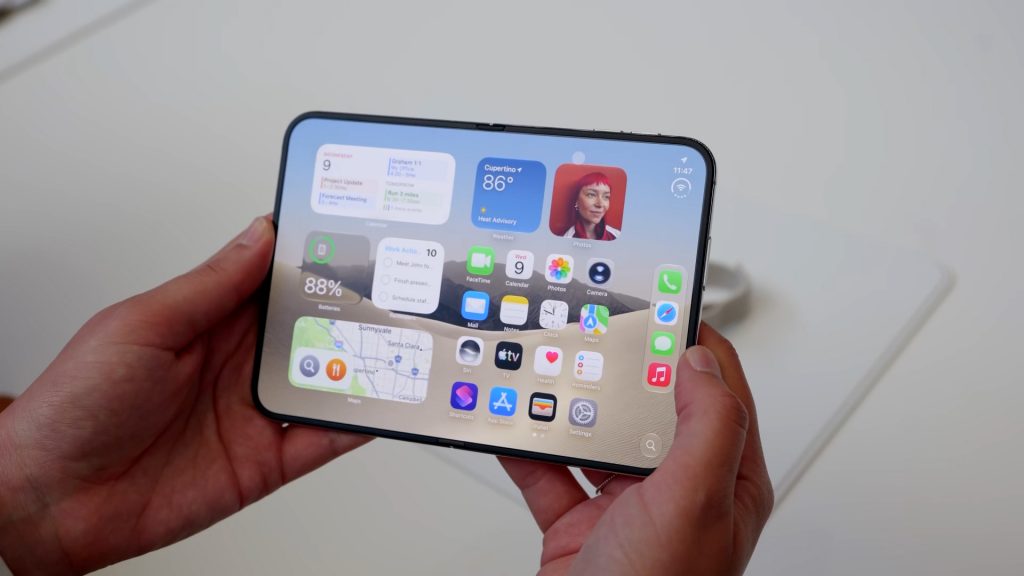
Commentary: Apple’s $1,999 foldable isn’t meant to be a crowd pleaser. It’s an option for people who want something different – and can afford it.
Abrar Al-Heeti
The iPhone Duo‘s launch has sparked a duality of opinion: Is it worth upgrading to Apple’s new foldable phone?
The conversation around the $1,999 device, which becomes available Oct. 23, is everywhere – and not just in the comments of my Instagram Reels showing the new phone in action. Commentaries and social posts about the headline-grabbing device abound. And despite Android foldables having been around for years, I’ve received more questions about the iPhone Duo than any other foldable. Even CNET’s own reporters are divided on whether it’s worth buying.
I’m holding off on forming a final opinion until I’ve had a chance to properly test the iPhone Duo. My limited time with the phone at Apple Park simply isn’t enough to make a definitive call. What I can say with some certainty, though, is that Apple isn’t expecting everyone to rush out and buy its flashy new handset.


Foldables have been a niche category since their inception, and they’re likely to remain one even with Apple’s entry into the market. Globally, cumulative foldable phone shipments in the eight years since the category launched are slated to surpass 100 million units by the end of 2026, according to Counterpoint Research. That’s a significant number, but also just a fraction of the billions of phones sold in that period, including a projected 1.07 billion total smartphone shipments this year alone.
For many consumers, the biggest deterrent is the price. The passport-size Samsung Galaxy Z Fold 8, for example, starts at $1,900, while the more traditional book-style Google Pixel 11 Pro Fold and Motorola Razr Fold fall in the same price range. There are more affordable options, such as the clamshell-style Motorola Razr, but even that starts at a not-insignificant $800. Many people may struggle to understand why they need a foldable phone when their (less expensive) slab phone does the trick just fine.


Apple is likely aware of this, which is why the iPhone Duo exists as an option rather than a replacement for any of the company’s existing models. Its release alongside the iPhone 18 Pro and Pro Max signals that the Duo is positioned as an ultra-premium device for those who want something fresh – and who have the money to spare. Reports suggesting the iPhone Duo will be available in limited quantities reinforce its place as a status symbol for Apple’s biggest fans who are willing to branch out.
“I don’t think the brands want to make [foldable phones] mainstream in terms of volume,” says Nabila Popal, senior research director at IDC. “It’s a very intentional portfolio strategy to have different devices cater to different demographics, and I think that’s what Apple has really achieved with this launch.”
Foldable phones aren’t for everyone
As unique and distinctive as foldable phones are to use, they don’t offer much of a selling point to most people. Despite rampant complaints about smartphones being too predictable and boring, people also tend to like what’s familiar and, more importantly, what already works well for their needs. Traditional smartphones – even more budget-friendly options – have optimized just about every element from cameras to battery life to display quality.
Still, foldable phones are a breath of fresh air in such a stagnant industry. Their versatile design is ideal for consuming vertical and horizontal content, as well as for multitasking. They’re also quite a statement piece at any gathering, eliciting curious glances and inquiries from fascinated onlookers.


Before the iPhone Duo’s release, 75% of adults said they were uninterested in a foldable iPhone, according to a CNET survey. Now that the phone has debuted, those numbers could quickly change.
In fact, analysts predict the iPhone Duo could give the overall foldables market a significant boost. IDC forecasts that global foldable shipments will grow by more than 12% this year, with Apple’s entry driving much of that growth. The research firm also expects that Apple will ship more than 17 million foldable iPhones by 2027, giving the company a nearly 40% global market share by the end of next year.
“The category will remain niche, but it will gain popularity and visibility,” Popal says.
Despite growing interest, the high price will keep many shoppers at bay, she notes. But for consumers who have wanted a foldable phone without giving up Apple’s iOS – and who have therefore disregarded the range of Android options – the Duo could be particularly appealing.
How Apple’s foldable can stand out
Despite Apple’s late entry into the foldable phone market, unique touches could help the Duo stand out from even the most well-established players, such as Samsung’s Galaxy Z Fold series.
One example of how Apple’s hardware and software expertise could elevate the foldable experience is the seamless way content moves from the Duo’s cover display to the inner screen as soon as you open the phone. That cascading effect highlights Apple’s ability to optimize the interface across both screens, making the transition feel fluid and visually striking.
The matte inner display adds another layer of polish. It reduces reflections and makes the crease less noticeable, while giving the screen a more refined feel. And while the Duo can only run two apps side by side, setting up a multitasking layout is much easier than on competing Android foldables, where the process can often feel finicky.
“Those touches are what make the Duo stand out and feel extremely premium; it’s just a good experience,” Popal says. “Apple is great at making you want something that you didn’t know [you wanted] before.”

Perhaps that advantage could pressure competitors to improve their software and elevate the foldable experience on their own devices. Apps like Instagram, for example, still aren’t always optimized for the wider inner displays of foldable phones, though passport-style foldables like the Galaxy Z Fold 8 do a better job of accommodating vertical content in portrait orientation. And while developers on the Android side have to contend with a range of devices as well as form factors (clamshell, book-style, passport-size, etc.), Apple has one foldable experience they can really work to perfect.
A familiar feel, but not for everyone
While some detractors say they’d prefer a flip-style iPhone to the Duo’s compact book-style design, Carolina Milanesi, president and principal analyst at Creative Strategies, argues that the Duo’s more versatile build and 1.4:1 aspect ratio give it greater practical appeal, especially for entertainment.
Similar to the Galaxy Z Fold 8, it feels intuitive to flip the Duo to portrait orientation when viewing vertical content on the 7.6-inch inner screen, then revert to landscape for horizontal videos. The 5.4-inch cover screen on the Duo is also more functional and spacious than a flip phone’s.
“When you hold it, it feels familiar because you have so many other analog objects that are kind of the same [size], whether it’s a Moleskine [notebook] or your passport,” Milanesi adds.

Plus, Popal notes, flip phones are less pricey than book-style options, and Apple is marketing the Duo as one of its most premium products.
Ultimately, the iPhone Duo is just that: a premium option amid a lineup of Apple devices that cater to whatever you need: baseline features with the iPhone 17, a lighter and thinner handset with the iPhone Air or a more affordable pick with the iPhone 17E. And for photographers who are deterred by the Duo’s lack of a telephoto camera, the iPhone 18 Pro and Pro Max will gladly help you part with your money.
“At the very beginning, Samsung positioned the Fold as the best, as the future of smartphones, and that’s not what Apple is doing at all,” Milanesi says. Rather, from the start, the Duo “is an option.”
For those who are enamored but don’t want to fork over nearly two grand upfront, carrier trade-ins and Apple’s Upgrade leasing program could sweeten the deal. But for others, the Duo will remain an acquired taste.
“It’s a bit of a Marmite: You either love it or hate it,” Milanesi says.
And Apple will be perfectly OK either way.
The Latest from Abrar
The iPhone Duo Isn’t for Everyone. It Doesn’t Need to Be
5 iPhone Duo Features I’m Already Dying to Try
iPhone 18 Pro vs. Galaxy S26 Ultra Photo Comparison: I Put Apple’s and Samsung’s Top Cameras to the Test
Mobile Guides
- Best iPhone
- Best Phone
- Samsung Galaxy S24 Review
- Best Samsung Galaxy Phone
- iPhone 15 Pro/Pro Max Review
- Best Wireless Earbuds
- Best Headphones
- Best Wireless Earbuds and Headphones for Making Calls
- Best Noise Canceling Wireless Earbuds
- Best Cheap Wireless Earbuds
- Best Noise Canceling Headphones
- Best Over Ear Headphones
- Best Headphones for Work at Home
- Best Sounding Wireless Earbuds
- Best Wireless Headphones