


You’re used to artificial intelligence living on a screen. It writes emails, generates images and videos, answers questions and maybe even helps you code. But for the most part, AI has been a ghost in the machine, trapped in your pocket or your computer.
But what happens when AI leaves your device and starts moving through the real world? That’s when it gets a body.
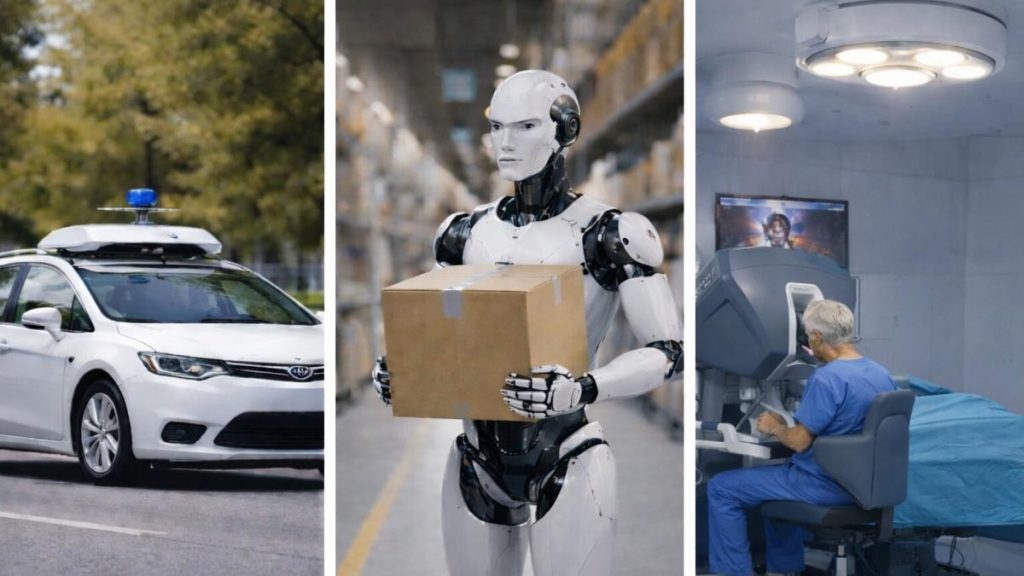
Physical AI refers to artificial intelligence systems embedded in machines that sense their surroundings, make decisions and perform actions using hardware. Think robots, self-driving cars, warehouse automation systems and surgical machines.
A PwC study, released in March 2026, projects the global physical AI market will reach approximately €430 billion ($500 billion) by 2030.
Let’s explore what these machines are, how far we are from truly autonomous systems and what it really means when intelligence can act, not just respond.
What is physical AI?
Physical AI is artificial intelligence embedded in machines that can perceive, decide and act in real-world environments.
Unlike chatbots, physical AI systems collect information from the 3D world using sensors such as cameras, microphones and lidar (laser-based distance sensors). They can also use environmental sensors that measure temperature, pressure, humidity and vibration to understand what’s happening around them. They process that information in real time and then control motors, wheels, robotic arms or other mechanical components to respond.
«Physical AI is definitely not just a ChatGPT inside a robot,» Zhengyang Kris Weng, a robotic systems engineer at Sunday, tells CNET.
A chatbot might hallucinate a citation for your thesis. But a delivery robot that misjudges distance could crash into someone.
How physical AI works
Physical AI operates in a constant loop of perception, decision, action and learning. It begins when a machine tries to make sense of the world through data collected from its sensors.
But what the system sees isn’t a clean movie.
It’s a chaotic storm of data points where the AI has to be able to distinguish a child’s backpack from a mailbox during a heavy downpour, for instance.
To interpret that flood of information, systems rely on several types of AI. Computer vision analyzes what the cameras see. Machine learning models recognize patterns and predict what might happen next. Reinforcement learning allows the system to improve through trial and error, learning which actions lead to better outcomes. Some newer systems also use agentic reasoning to plan multiple steps ahead and coordinate complex actions.
Once the system forms a picture of its surroundings, it has to decide what to do. This is the split-second logic where the AI determines whether that plastic bag blowing across the road might be a harmless shadow or something a self-driving system should slow down for, like a rock.
That decision then becomes movement. The AI sends commands to hardware, turning them into actions such as steering a vehicle or gripping an object with a robotic arm.
In the case of a self-driving system, if any part of the loop lags even for a fraction of a second, it doesn’t just glitch — it crashes. Weng tells CNET that a wrong robot action can even damage the robot itself, and if the system isn’t trained to handle unfamiliar situations, it could fail pretty badly in the real world.
Avoiding objects is the easy part. Teaching a robot to manipulate them is much harder. A digital AI lives in a world of clean datasets. A physical AI lives in a world of wet pavement, glare on camera lenses and unpredictable people and animals that don’t follow the rules of a dataset. It has to juggle perception, reasoning and motion simultaneously, hundreds of times per second.
Examples of physical AI
Some forms of physical AI already operate in the real world. Self-driving cars or autonomous vehicles such as Robotaxi and Waymo are some of the clearest examples. Waymo and Tesla use AI models to interpret sensor data and control vehicles.
Weng says many people don’t realize that self-driving cars are essentially robots.
«They are out there on the road, collecting data. And that’s a very good example of having data feeding into a model that helps to generate more data. This is what we call a data flywheel,» Weng tells CNET.
Robots come in many forms, from humanoid or general-purpose robots like Tesla’s Optimus to industrial robots in warehouses like Amazon’s Vulcan robot that use AI to identify, sort and move packages. Surgical robotics like da Vinci systems assist doctors with precision movements. Even your Roomba is a basic form of physical AI. It no longer slides like a bumper car. Instead, it uses visual simultaneous localization and mapping to build a mental map of your floor plan.
Physical AI is also being used in smart spaces and smart cities. Singapore, for example, uses a digital twin — a virtual 1:1 replica of the city — to run simulations. In the future, physical AI may help run entire cities, as seen in projects such as Toyota’s Woven City in Japan.
All of these systems combine machine learning with physical hardware, but most remain narrowly focused. A warehouse robot may excel at picking boxes yet be incapable of navigating a grocery store. Likewise, a self-driving system may handle highways well but struggle with unusual situations like construction zones or erratic human drivers.
Why physical AI is different from generative AI
Generative AI models such as ChatGPT predict patterns in text, images or audio. Physical AI models must predict outcomes in dynamic, real-world environments.
Generative AI is trained on the internet, which is a massive and static library of text and image data. Physical AI is trained on reality, and reality is expensive. You can train a chatbot on billions of words for little more than the cost of electricity and servers. Training a self-driving car is different: You actually have to drive it, accounting for gravity, black ice or even a stop sign covered in graffiti.
Collecting that data is slow because machines must physically move, interact with objects and observe the environment in real time.
To lower these costs, developers use digital twin simulations and world foundation models to create synthetic data. These systems generate hyper-realistic virtual training grounds where robots can master physics and rare emergencies without risking a real-world crash.
Even so, simulations are far from perfect.
«There are still a lot of very complicated contacts, frictions … that are really hard to simulate and really hard to make it realistic for robots to understand the difference between a simulation and the real world,» Weng tells CNET.
Challenges, safety and reliability
The moment AI leaves the screen, reliability becomes everything. Physical systems must operate in environments that are inherently unpredictable. Sensors can fail, cameras can be blinded by glare and people behave in ways no training dataset can fully capture.
«Reliability is probably overlooked a lot of times. It could still be unsafe and making a lot of decisions, especially under uncertainty,» Weng warns.
Most systems today are designed to handle common scenarios well. The real challenge is the edge cases: an overturned chicken truck or a deer darting into the road. That’s when these systems are tested most.
«Once you disturb any scenario around it, it could feel that, ‘Hey, I haven’t really seen this before,’ and it doesn’t know what to do. And it might just freak out in there,» Weng says.
And unlike software, you can’t simply CTRL+Z a mechanical mistake. A buggy app can be fixed overnight with an update; a robot malfunction or vehicle collision has real-world consequences.
«(Physical AI) actually has the ability to alter the physical environment around itself. And it can exert force and torque onto objects. And then these will have physical consequences,» says Weng, as this poor guy in the video below discovered.
That raises questions about standards and responsibility. How safe is safe enough before deployment? Weng tells CNET, «We’re kind of still far from having ideally layered protection and safeguards … If it has like 99% reliability and one time out of a hundred it’s wrong, it can still make quite a mess.»
Where is physical AI headed?
Researchers and companies are now exploring what’s often called embodied AI, where machines learn by doing, not just by reading. The idea is that intelligence becomes more powerful when it is grounded in physical interaction.
Experts often point to robots that could assist in elder care, machines that could help with disaster response or agricultural systems that monitor crops autonomously. Warehouses could operate with greater automation, and city transportation could become more autonomous.
«Most likely, robots will show up in a lot of places where tasks are repetitive and where environments are somewhat structured,» Weng says.
Physical AI already exists in limited forms. AI started as something you typed to. Now it’s something that can move.