


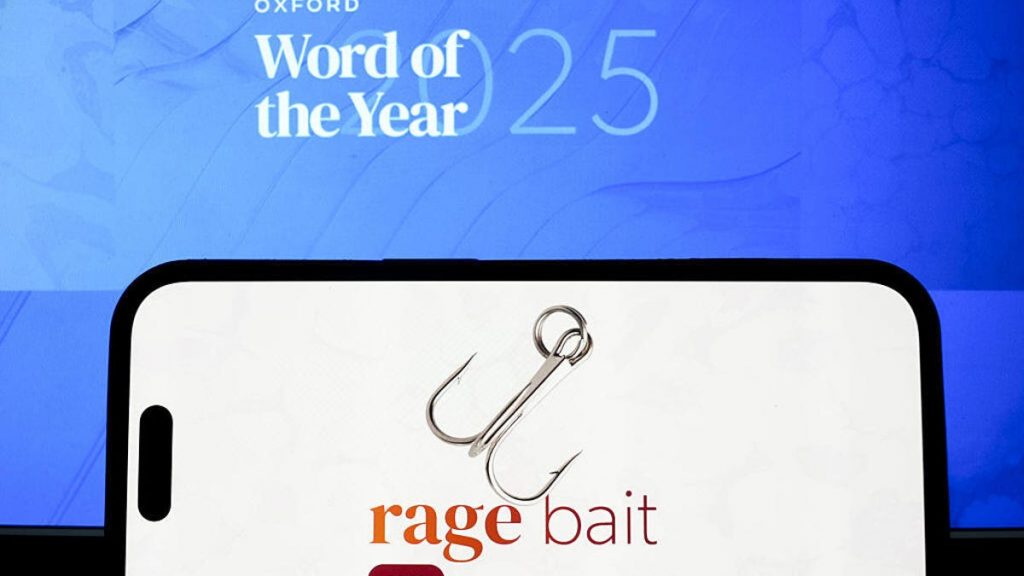
In a move reflecting the darker side of the social-media era, Oxford University Press has named «rage bait» as its 2025 Word of the Year. (It’s actually two words, but don’t let that send you into a rage.) The phrase refers to online content deliberately designed to provoke anger or outrage by being provocative, offensive or otherwise manipulative, with the explicit aim of boosting engagement, clicks or shares.
According to Oxford University Press, usage of rage bait has roughly tripled over the past year. In announcing the choice, the organization noted that this surge isn’t just a change in vocabulary. It points to a larger shift in how online platforms and content creators capture attention, often by exploiting emotional triggers rather than curiosity or honest interest.
Casper Grathwohl, president of Oxford Languages, said that this trend marks a progression from earlier waves of click-driven sensationalism toward a more emotionally manipulative digital environment — one where outrage, not intrigue, is the currency that pays.
«Rage bait shines a light on the content purposefully engineered to spark outrage and drive clicks,» Grathwohl said. «And together, they form a powerful cycle where outrage sparks engagement, algorithms amplify it, and constant exposure leaves us mentally exhausted. These words don’t just define trends; they reveal how digital platforms are reshaping our thinking and behaviour.»
Don’t miss any of our unbiased tech content and lab-based reviews. Add CNET as a preferred Google source.
2025’s other big words include ‘parasocial’ and ’67’
Rage bait isn’t the only word or phrase gaining recognition this year. Two other major dictionaries have picked their own Words of the Year, each illuminating a different facet of our cultural moment.
- The Cambridge Dictionary named «parasocial» as its 2025 Word of the Year, capturing the growing phenomenon of one-sided relationships people form with celebrities, influencers, fictional characters — and now, increasingly, with AI personalities. The word reflects how many of us now treat virtual or distant figures as if they were friends, despite knowing that the connection is unreciprocated.
- Dictionary.com selected «67» as its Word of the Year. Pronounced «six-seven,» this term is a slang expression that’s playful, ambiguous and rooted in meme culture. While 67 might not carry a dictionary-style definition, its rise points to how younger generations express attitudes of indifference, irony or insider-like humor in the digital age.
A quick look back at some past Words of the Year
To understand what 2025’s picks reveal about our time, it helps to glance at some past winners, which show how language shifts in response to social moods, technology and world events.
- In 2024, Oxford’s Word of the Year was «brain rot,» a phrase meant to capture the mental fatigue, dissatisfaction, or dulling sensation people feel after endless scrolling through trivial or low-quality online content.
- 2023’s winner was «rizz,» a slang term for charisma or personal charm.
- In 2022, the winning phrase was «goblin mode,» reflecting a mood of laziness, self-indulgence, or rejecting social expectations — especially as the world grappled with pandemic aftershocks.
Earlier years show a variety of themes. 2019’s climate emergency stood out as concern over global warming surged. In 2016, «post-truth» became the word, capturing a time of political upheaval, misinformation and shifting trust in facts.