


I can’t predict the future, but I know that 2026 is going to be a great year for all makers, especially in the realm of 3D printing. How do I know? I’ve been reviewing 3D printers and maker tools for nearly a decade. Crafting technology is becoming increasingly mainstream with each passing day, opening up new realms of possibilities for makers, digital fabricators, hobbyists and DIY enthusiasts.
Over the years, I’ve seen a lot of trends lasting and growing to new heights, while others burn away as quickly as they arrive. Of course, with each bright step toward more accessible creative technology, there’s bound to be some dark spots (you probably can guess what I’m going to say here). If you’re part of the maker community, here’s my list of predictions for what we’ll see in the coming year and what tech will have the most impact.
UV printers are going to be huge
Early in 2025, EufyMake announced a Kickstarter for a UV printer that was mind-blowing. The E1 allows you to print colored and textured ink onto just about any hard surface. It was immediately one of the most funded Kickstarters of all time.
UV printing is a digital process that uses thin layers of white paint, dried very quickly with ultraviolet light, to build up texture. This allows you to print durable, high-detail designs and vibrant colors on non-traditional surfaces. Essentially, it involves creating a textured 2D image with small amounts of 3D texture on any hard surface, such as wood, plastic, metal or glass.
While reviewing it, I fell in love with the sheer number of products that could be produced from one machine. Since then, the company has had some issues, a lot of which are due to the nature of having an overly successful Kickstarter, but the full retail product should be available in 2026.
EufyMake is just the beginning, though. This year, we’re going to see a lot of other companies jump into UV printing and push the technology forward. We might even see a small, consumer version of the Mimaki 3D printer that uses the same technology to make full-color 3D models. Etsy is about to become inundated with UV-printed artwork, for better or worse.
Accessible color 3D printing
The Bambu Lab A1 Combo has been my best 3D printer for all of 2025, and for good reason. It’s cheap, works great, and is easy to set up and use. Now, though, we are seeing new printers that can match, if not surpass, the A1 in terms of speed, quality and price.
The AD5X from Flashforge is a good example of this, as is the newly announced Elegoo Carbon 2. Both are CoreXY printers that feature color systems built in, and both are in that $300 — $500 price range that’s good for just about anyone.
We will see more companies, such as Creality and Anycubic, continue to improve their base price printers to offer us more color options without additional cost in 2026.
3D printers with more nozzles
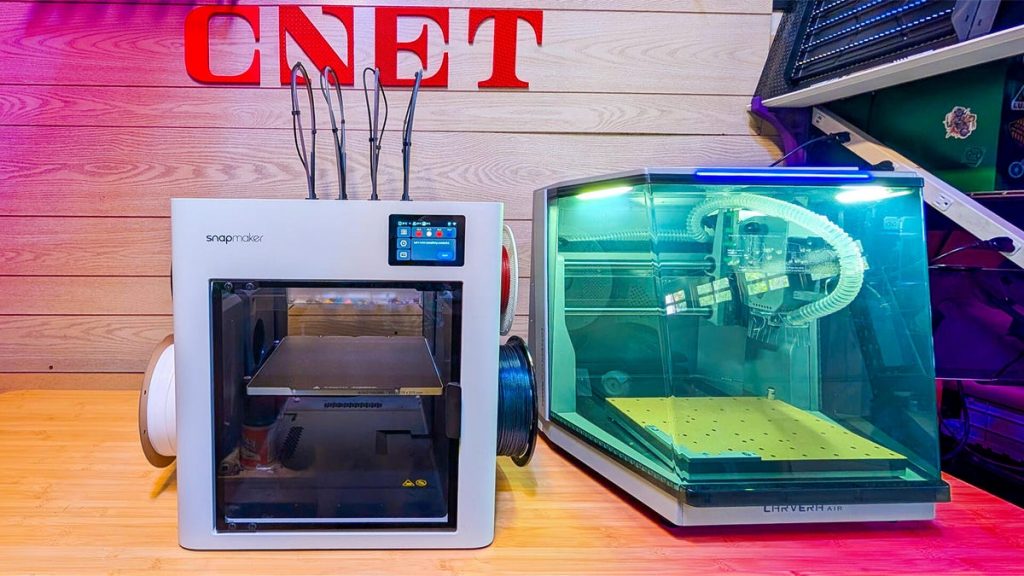
Another way 3D printers are changing is the number of nozzles they have. I recently reviewed the Snapmaker U1, a 3D printer with four separate print heads that can print in 4 colors without leaving a lot of plastic waste. Normally an FDM 3D printer will use one hot end to extrude melted plastic. A tool changer like the U1 uses four separate tool heads to print four colors quickly. The U1 is genuinelya fantastic product, and when it’s finally released early next year, it’ll be well worth your time to pick up.
It’s not just the U1, though. Both Bambu Lab and Prusa have recently released or announced 3D printers with an Indx system. Indx systems — or Vortek, as Bambu calls it — uses multiple nozzles instead of multiple tool heads to swap colors and materials in and out on your machine. Not only is it faster, but, like the U1, it reduces waste material by a massive margin because you never have to purge a color from the nozzle to swap it.
Currently, these Indx systems are expensive, and 2026 will be a year of refining the process before we see these costs decrease significantly. But if you’re into the cutting edge, Indx is where you want to be.
More accessible lasers
Laser engraving and laser etching — using high powered lasers to burn away material in a pattern —are one of the fastest-growing sectors for Etsy and hobbyists. Right now, you can spend thousands on a massive laser like the xTool P3, which is shaping up to be my new best laser engraver once the testing is finished, but we are starting to see more affordable options. There have always been inexpensive lasers, but they tend to be gantry styles with no real safety features. 2026 is going to bring us more cost-effective laser engravers without sacrificing safety.
The news that Glowforge — one of the biggest names in at-home lasering — has filed for an Assignment for the Benefit of Creditors (ABC) to restructure the business to save it from bankruptcy is concerning. These big laser machines aren’t always the way to go, and cheaper lasers like the xTool M1 are paving the way for usable machines under a thousand dollars.
Expect more AI Slop
Every new laser engraver, DTF printer, UV printer and even 3D printer in 2026 will have somewhere in the software to spend your hard-earned money to make AI-generated artwork for you to use as you see fit. Almost all of it will be what we call AI slop, and as the AI image generators get better and better, it will be almost impossible to tell it from artwork that a human has created.
CNET’s AI expert Katelyn Chedraoui said in a review of Nano Banana that the software «…obliterates the line between reality and AI. And this is the worst this model will ever be.» That should frighten us all who love to create art with our hands.
I wish I could say that 2026 will be the year this bubble bursts, but I don’t see AI slop going away any time soon. Be on the lookout for your local farmer’s markets being flooded with variations on a theme built out for stolen art and computer logic. What we might see in 2026 is more regulations from places like Etsy on what AI products can be sold and still be considered «hand-made» enough to sell there.
At home CNC mills have arrived
The final piece of the machining puzzle that hasn’t yet made its way into people’s homes is CNC milling. It can be difficult to set up, requires a lot of different tools, and can be very messy. Like Laser engraving, CNC mills remove material to create a pattern, as opposed to UV or 3D printing, which adds material. Snapmaker originally tried this with the Snapmaker 2, but the execution was clumsy and the software subpar.
Makera has been working on bringing small CNCs to your home for a while now, and while its current small machine, the Carvera Air, is easier to use, the company is looking to release the easiest CNC ever in 2026. Called the Makera Z1, it’s set to be the simplest CNC on the market.
The final piece of the CNC puzzle is the software. Like a lot of maker tools, the current crop of CNC software is pretty difficult to use and geared toward commercial use rather than at-home use. 2026 will bring improved software in the form of Millmage, from the makers of Lightburn, one of the best laser engraving tools available. This combination of new software and more home-friendly machines will make 2026 the year you invest in a CNC mill.
I’m excited for 2026
Creating things with cool technology is my greatest passion. I’ve recently got into leather working — because I needed more things to do with all my free time — and using a laser cutter to help me cut out templates or cut the leather itself has been immensely satisfying. The tools I use to help me create are getting better every year, and, with CES 2026 just around the corner, we are likely to see even more cool new gadgets to help us create.
Despite the preponderance of AI slop that might be generated on these machines, I think UV printers are going to be next year’s biggest craze. It’s something new and interesting, and while 3D printing will undergo some big changes, this new medium is going to make a big splash in 2026.