


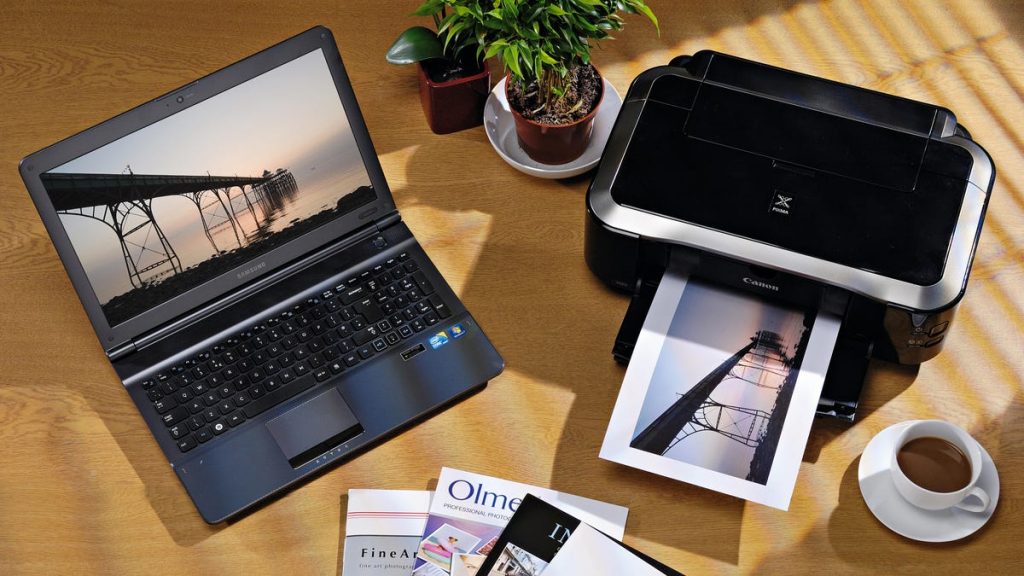
Shopping for a printer largely boils down to choosing between inkjet and laser. Both put text and images onto paper, which seems straightforward enough, but they differ in how they do it. Which you choose will affect your print quality, speed, pricing and ongoing costs. Understanding their pros and cons will save you money and annoyance for years to come.
Inkjet pros:
- Lower upfront cost
- High-quality color printing, including photos
- Most models are smaller than laser printers
Inkjet Cons:
- Ink is where printer companies make their profit
- Ink cartridges dry out if not used regularly
- Most printers won’t print anything if any color is out
Laser Pros:
- Fast and clean text printing (though there are color models)
- No ink to dry out
- Toner cartridges typically last a long time
Laser Cons:
- Higher upfront costs
- Toner is more expensive to replace (but usually cheaper per page)
- Most are physically larger than the average inkjet model
Inkjet printers vs. laser printers: Printing technologies
Inkjet printers use liquid ink housed in replaceable cartridges or tanks that sit inside the unit. Ink is sent from the cartridge or tank to the printhead, where microscopic nozzles spray tiny droplets onto the paper. Because it precisely controls how the ink is delivered, inkjet printers perform well for color photos and graphics. They can also support different paper types and sizes, including photo and cardstock. Inkjet printers come in different shapes and sizes, from sub-$100 entry-level models to large, heavy prosumer units.
Laser printers, on the other hand, use a powder, called toner, that’s contained in a replaceable cartridge. A laser beam, guided by mirrors, creates an electrostatic image on an electrically charged cylinder (a drum), which attracts the toner and bonds it to paper via heat and pressure. The process is complex, but actual performance is fast and consistent, making laser a great option for printing large volumes of text quickly.
However, even the smallest laser printers will take up significant space due to the volume required to house all the components. Even compact laser printers tend to be larger than the average inkjet model. Units that offer multiple paper trays and functions can be as large as a small photocopier, which shares a similar technology to laser printers.
Similar to laser printers are LED printers. Instead of using a laser beam and mirrors, this technology uses a fixed array of light-emitting diodes, or LEDs, to create the electrostatic image on the drum, reducing the number of moving parts. For most people, LED and laser printers perform similarly, with comparable print quality, speed and operating costs, which is why the two technologies are often grouped together.
Inkjet printers vs. laser printers: Print quality
With their ink-drop precision and smooth gradients, inkjet printers typically produce high-quality photo prints, especially higher-end models that use many ink colors. Drying time varies depending on paper type and ink, which can lead to smudging if handled immediately. Printer manufacturers have improved their ink formulas to dry faster, though often just on certain types of paper.
Laser printers are known for their ability to quickly output documents with crisp text and graphics on standard printer paper. The heat-and-pressure process ensures instant drying. Most laser models print in monochrome (black and white) and are designed for high-volume printing. Color laser printers can add impact to documents, but inkjets are better suited if photo printing is the primary task. Most monochrome and color laser printers have limited support for specialized paper.
Both inkjet and laser have made great strides over the years. Advancements in printheads, inks and nozzles have improved not just print quality but also speed and drying times. Office inkjet printers can also handle greater volume. Color laser printers deliver better color accuracy than earlier models, while consistency in quality makes laser the best choice for heavy print jobs.
Inkjet printers vs. laser printers: Performance
Laser printers are generally faster than inkjets. They are designed to be workhorses that can handle high-volume printing; many laser models support large-capacity paper trays, making them a logical choice for offices and schools to share among many users.
Inkjets are typically slower, as the printhead needs to move across the paper. High-resolution color prints require even more time. This makes them better suited for homes or any environment that requires occasional or specialty printing. Some office inkjet models can handle higher speeds, however.
Inkjet printers vs. laser printers: Cost
Inkjet printers have a lower upfront cost. A basic model could be had for under $50. The cost increases when you move up to premium units, like photo-specific or office printers. Supertank printers with refillable ink tanks also cost more.
Speaking of ink, when it comes to long-term costs, ink replacement is where inkjets get expensive. Depending on usage, ink can run out quickly, and it’s pricey, especially with printers that use multiple inks. Ink can also clog nozzles or dry out when unused, which could lead to additional maintenance expenses. Heavy use could also shorten the machine’s overall lifespan.
Laser printers tend to cost more at the time of purchase. Even the cheapest models will cost around $150 to $200, while the least expensive color laser printers will set you back $200 to $300 or more. While toner is expensive, it lasts much longer than ink, has a longer shelf life and has higher page yields. Because they’re designed for high-volume printing, laser printers can also handle heavier, frequent usage.
Other considerations
In general, inkjet printers are smaller and lighter, while laser printers are heavier and larger. There are plenty of exceptions, of course: A wide-format inkjet photo printer can take up significant space and is extremely heavy, while compact, single-function laser printers are easier to move and can sit on a desk. Whether laser or inkjet, a multifunction printer that has a scanner will also be bulkier than a single-function unit.
Some printers also support high-yield cartridges that hold more ink or toner. While they are a bit pricier than standard cartridges, they could offset some long-term printer costs.
Many modern printers support wireless printing via Wi-Fi and mobile platforms such as AirPrint and Mopria. This lets you place a printer anywhere in a home or office and supports printing from a variety of devices.
Which is best?
The best way to figure out which is best for you is to determine your printing needs. Not just what you’re printing, but how much and how often. Are you regularly printing documents or photos? Do you print a few times a week, or once every few months? Do you need something that scans, copies, or maybe even faxes? Will multiple people need to use it?
Next, factor in your budget, not just the upfront cost (the machine itself), but long-term (ink or toner and maintenance). Consider that if you don’t use it often, the ink could dry up and the printer won’t work when you need it. Most inkjet printers won’t print if any of their inks are low or out. While they have a higher up-front cost, laser toner lasts longer per cartridge and won’t dry out between infrequent prints. In other words, laser printers are more likely to be able to print if you let them sit for weeks or months between printing.
Also consider that many stores, including pharmacies, Walmart, FedEx and more, can cheaply and quickly print out photos. This might be more affordable and less annoying in the long run compared to owning and maintaining an inkjet printer if you’re not printing photos regularly.
As a general rule of thumb, most inkjet printers are cheaper up front, but might cost more in the long run due to the nature of their ink. They’re best for regular printing of color documents and photos. They may be affordable at first, but they will cost you in supplies.
Laser printers are more expensive up front, but are generally cheaper to maintain. If you don’t print regularly, toner cartridges can last for years. Laser printers are also great for high-volume and fast print jobs, but most are limited to printing black-and-white documents.