


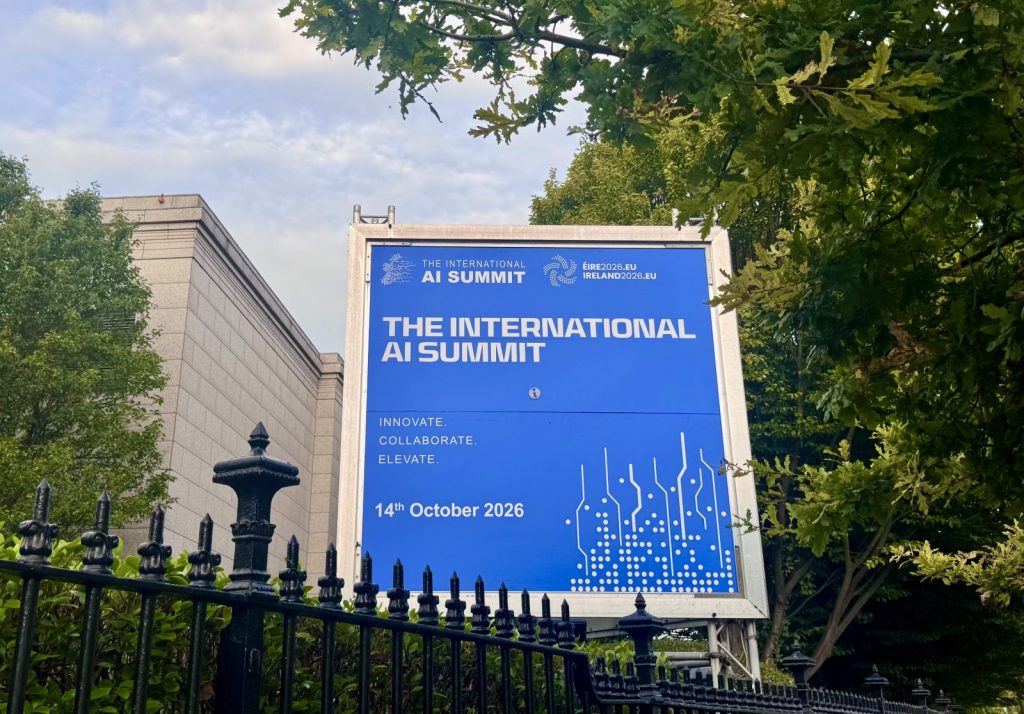
Google DeepMind chair and co-founder Demis Hassabis took the main stage at the International AI Summit in Dublin, Ireland, on Wednesday morning to speak to global ministers, media and delegates about innovations in science and math, frontier AI and – taking a hopeful tack – the potential for AI to address climate issues.
“I actually think with the help of AI, that’s what’s going to end up giving us the technology to tackle the climate question,” he said.
During his chat, Hassabis briefly mentioned this week’s rollout of Google’s new Gemini 4 Argon model and the debacle around OpenAI’s claim to have solved the Navier-Stokes equation, one of history’s most difficult mathematical problems. But perhaps the most interesting aspect of his chat was what Hassabis did not say: AGI was not mentioned once.
In May, I attended the Google I/O event in Mountain View, California, and listened to Hassabis speak at length about the power of artificial general intelligence – the hard-to-pin-down concept of AI that matches human intellectual capabilities – calling it the “foothills of the singularity” and estimating that achieving AGI is on the horizon.
Five months later, a status report on progress toward AGI seemed to have slipped his mind.
Instead, Hassabis opted to use his discussion time (a 20-minute slot following Executive Vice President of the European Commission Henna Virkkunen) to outline how AI excels in disciplines such as mathematics, coding and games like Go and those from Atari .
He contrasted its success in those areas with its ability physical and natural sciences – physics, chemistry, biology, engineering – which require “real-world loops” of human creativity and judgment, intuition and curiosity in creating hypotheses and developing lines of inquiry.
In 2024, Hassabis and DeepMind colleague John Jumper, along with University of Washington scientist David Baker, won the Nobel Prize in chemistry for their work on an AI model that can predict protein structures
“I think that’s the hardest thing in science is actually asking and articulating the right question,” Hassabis said. “That’s even harder than finding the answer.”
AI and the climate crisis
Before exiting the stage in Dublin, Hassabis was asked about AI’s significant sustainability problem. The massive push to build sprawling, energy-hungry data centers is spurring a surge in demand for fossil-fuel power plants, a key driver of the climate crisis.
Rather than acknowledging the stresses that data centers are exerting on our energy grid and natural resources, he expressed optimism about the potential for using AI to drive breakthroughs in green technology, clean energy and models for predicting natural disasters like floods, fires and hurricanes.
“The most important thing is that the AI systems we’re building, if we build the right types, should be able to help with things like climate modeling and weather modeling,” Hassabis said.
“Looking further forward,” he said, “AI systems will help with new sources of energy — fusion plasma containment for fusion reactors, new materials like superconductors, better batteries and better solar materials. I actually think that with the help of AI, that’s what’s going to end up giving us the technology to tackle the climate question.”
Editor’s note: Macy Meyer’s travel costs for the International AI Summit were covered by Enterprise Ireland. The judgments and opinions of CNET are our own.