


December is a busy month between the holiday season, the winter solstice and the occasional aurora borealis. It also hosts one of the best meteor showers of the year, with the Geminids. This often underrated meteor shower doesn’t get the attention that the Perseids meteor shower gets, but it often rains down just as many meteors if you’re willing to brave the cold to go out and see them.
Don’t miss any of our unbiased tech content and lab-based reviews. Add CNET as a preferred Google source.
Geminids, known for its bright, colorful shooting stars, began the show on Thursday and will end on Dec. 17. It’s not the longest-lasting meteor shower, but don’t let its short length fool you. It has one of the most active peaks of any named meteor shower and is capable of throwing over 100 meteors per hour in a good year, according to the American Meteor Society. The Geminids meteor shower peaks on Saturday evening.
It comes to Earth thanks to the 3200 Phaethon asteroid. This is unusual because most meteor showers are fed from comets, which tend to have tails made of ice, dust and rock. Asteroids are made of rock and metal, and don’t typically have tails. That makes the 3200 Phaethon’s tail unique. The only other major meteor shower that is fed by an asteroid instead of a comet is January’s Quadrantids meteor shower. The rest are fed by comets.
How and where to see Geminids
The Geminids meteor shower peaks on the evening of Saturday. During its peak, the AMS says that it can spit out upwards of 150 meteors per hour, although NASA predicts a much tamer 40 to 50 meteors per hour and its peak to occur on Friday. For the best results, we recommend going out on both nights, just in case.
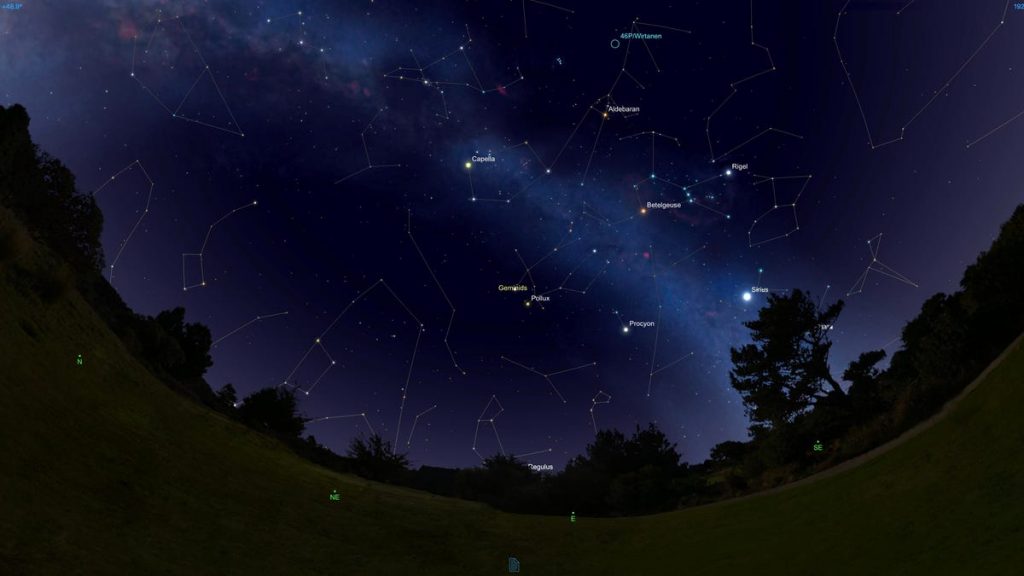
Like all named meteor showers, the Geminids name is the clue for where to find them. The radiant, the point from which the meteors will appear to originate, is in the Gemini constellation. Per Stellarium’s sky map, Gemini will rise out of the eastern sky just after sunset in the Northern Hemisphere. It’ll be accompanied by Jupiter, so if you can find Jupiter, you’re looking in the right spot. Gemini will streak across the sky before ending up on the western horizon at sunrise.
For the best results, the usual skygazing rules apply. People in the city probably won’t see any meteors, while those in the suburbs may see only one or two. The optimal viewing experience occurs when you leave the big city to escape light pollution. Then all you have to do is face yourself toward Gemini and Jupiter and wait. Your eyes may need upward of 30 minutes to adjust to the darkness, so patience is a virtue.
As with most meteor showers, you won’t need any special equipment, and experts recommend that you not take any. Binoculars and telescopes restrict how much of the sky you can see, which may cause you to miss a meteor. The moon, a common source of light pollution when skygazing, will only be 30% full, which means it’s unlikely to inhibit meteor shower viewing.
Michelle Nichols, director of public observing at the Adler Planetarium in Chicago, also recommends dressing warmer than you think you’ll need, since you’ll be outside for a while. She also recommends refraining from alcohol since it can cause you to lose heat faster. This is especially important if you live in the Northeastern US, where another polar vortex is going to drive down temperatures. Make sure to dress appropriately and stay safe.