


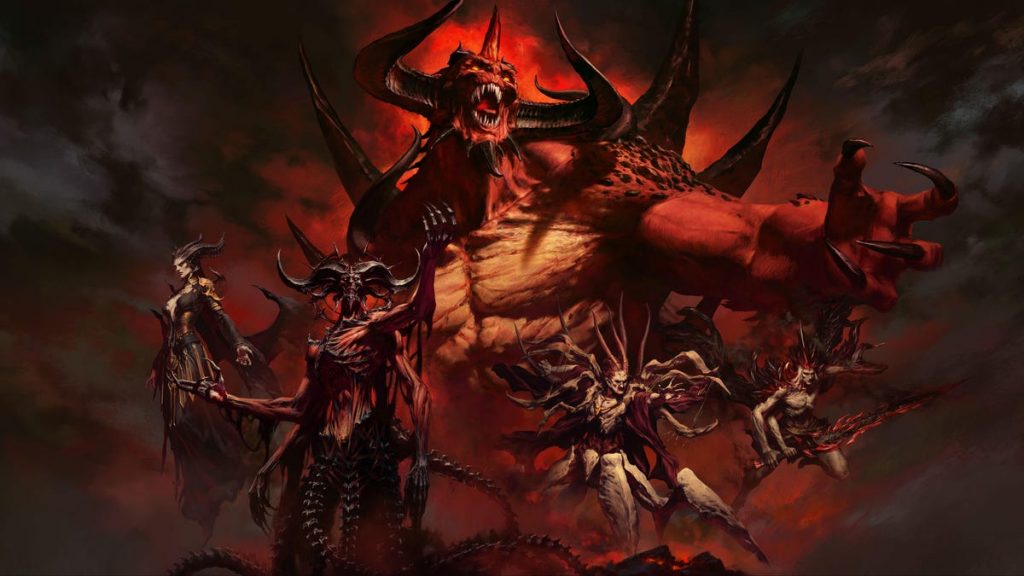
The paladin has had its time to bask in the Light of Diablo 4. On Wednesday’s Diablo Spotlight stream, Blizzard showed us the new warlock class that has emerged from the action RPG’s shadows to fight hellfire with hellfire… and demons.
Whereas the paladin was a fan-favorite holy warrior class that originally debuted in Diablo 2, the warlock is an entirely new creation. With a mix of apocalyptic spells and the ability to summon demons, the newest class gives players a heavy metal option for taking on the Prime Evils.
The warlock isn’t just showing up in the latest fight for Sanctuary — instead, it’s coming to Diablo 2: Resurrected today, Diablo 4 in April and the mobile-focused Diablo Immortal later this summer. That’s an unprecedented range of additions that introduces the warlock into the series’ history and future.
I was at Blizzard’s campus in Irvine, California, in late January to get a glimpse at the Diablo 2: Resurrected class and talk with devs about the warlock, as well as the upcoming Diablo 4 expansion. The new class was created with a sense of progression in mind: The warlock class appearing in Diablo 2 represents its origins, whereas the versions in Diablo Immortal and Diablo 4 will show how the demonic spellcasters have developed over time in Sanctuary.
«There was also this room for each warlock to kind of have its own expression, its own personality for each of the games,» Matt Burns, narrative designer for Diablo 4, told media in a group interview.
The Spotlight showcased details about the new Reign of the Warlock expansion for Diablo 2: Resurrected, which is available today. We also got more details about the new region, endgame features and other updates coming to Diablo 4 in April’s Lord of Hatred expansion. The warlock is also coming to Diablo Immortal in June, along with a return to the city of Lut Gholein (the desert port that first appeared in Diablo 2), now under the control of Andariel, one of the lesser evils.
Witness the warlock’s origins in Diablo 2: Resurrected
The warlock is the first new class added to Diablo 2 in a quarter of a century, and uses its powers to summon, bind and even consume demons. I got to play as the warlock briefly in a playtest at Blizzard last month ahead of the spotlight. It was admittedly my first experience with the famed D2 (which launched in 2000), but the vision and fantasy of the warlock class were immediately apparent, even to my newbie eyes.
Summoning and binding demons and then consuming them to fuel your own power fit seamlessly into the overall Diablo universe. I found myself devouring demons frequently just for the fun of zipping around the map with the additional speed. The hexblade build I played felt like a natural way to adapt the warlock concept in a Diablo game.
Game Designer Tim Vasconcellos said the Diablo 2 warlock is an «idealist scholar» who’s spent a lifetime studying the mysteries of creation, but jumps into the fire when things go wrong in Sanctuary.
«[The warlock is] descending from this life of luxury because he sees the world descending in madness again with the return of the prime evils … and he’s deciding to become a visible outcast instead of [remaining] in his life of luxury,» Vasconcellos said.
Adding a new class to a decades-old game, even a remaster, is a bold move, and the devs are aware that not everyone wants to follow the game down that path. That’s part of the reason the warlock will be included in an expansion, allowing people who like the classic Diablo 2 feel to keep it separate from the newer content.
When asked whether the Reign of the Warlock expansion was the first of multiple updates for Diablo 2: Resurrected, the devs said they wanted to make sure they got this launch right and take feedback from there.
Diablo 4’s new expansion promises more classes, more endgame activities, more viable builds
Warlocks are also coming to Diablo 4 in April’s Lord of Hatred expansion. Blizzard is keeping quiet on the details for now, but it seems like this version of the Warlock has jumped out of the demonic frying pan and into the hellfire. The Spotlight showcase said more info on the Diablo 4 warlock is coming early in March.
The Lord of Hatred expansion takes players to Skovos, the cradle of Sanctuary’s civilization, where Inarius and Lilith first created humanity. Nick Chilano, art director on Diablo 4, told media that it’s a large, varied region, but said the team wanted to dig into how to give the settings an identity, even though the regions change drastically over the course of the expansion.
«There’s a lot to [Skovos]. Where you start and where you end … it’s a bit of a journey and it connects so well to the story,» Chilano said.
Lord of Hatred is also revamping skill trees for all classes, offering players more variety and customization in how they build their characters. I asked Game Designers Colin Finer and Aislyn Hall about the philosophy behind the new skill trees and what the goals were when redesigning them. The main target is for players to use more diverse sets of synergistic abilities and equipment (called «builds» in gamer parlance).
«The topline goal is we want way more build variety. We want a much deeper, much broader set of builds in the game,» said Finer. He pointed to the viability of so many different Paladin builds, where customization is happening in the skill tree, compared to classes like the Barbarian skill tree, which is narrower in its ability to customize.
New features like the Horadric cube will make it easier for players to chase the specific build or character fantasy they want in the game.
Warplans are another major feature being added in Lord of Hatred, designed to answer the question of, «I’ve finished the game, so what do I do now?» Warplans let you queue up a series of endgame activities like Whispers, Helltides or Nightmare Dungeons and complete them in succession without having to traipse around the map. Completing warplan activities will earn you rewards, which you can use to power up your seasonal builds.
When asked about whether there was a definitive endgame, Finer said it wasn’t about pointing players toward any one event — instead, they want players to be able to jump between different activities: «Functionally, we try to create lots of different victory points for you to feel good about,» he said.
Season ranks are one example, as are warplans, giving players the opportunity to leave whenever they’re satisfied or continue grinding to take on tougher challenges.
Overall, the new expansion brings two new classes to the game, the new Skovos region, revamped endgame features like warplans and the new endless Echoes of Hatred events, overhauled skill trees and other system updates that help you manage and even upgrade items.
Lord of Hatred is also bringing fishing to Diablo 4, but journalists at the Spotlight struggled to get answers about what’s actually going on. We were told that it’s a Diablo spin on a classic gaming activity, and that it’s a good way to sightsee some of the game’s beautiful level design that you may have missed while you were knee-deep in demon guts.
We were also told, «Don’t get eaten.»
Celebrating 30 years of terror… and many more?
Just like Overwatch celebrating its 10th anniversary with a new ongoing narrative and 10 new heroes, Diablo is taking a big swing for its 30th anniversary with a new class for three different games.
Diablo 2: Resurrected’s Reign of the Warlock is setting the stage for transformative changes to the game, though purists can keep things separate by not picking up the DLC.
Lord of Hatred appears to be the end of Mephisto’s storyline, but it also seems to be a new start for the game and how it engages players. In the words of Finer, «We really are excited about the width we’ve added to the game, and we hope it pays off.»