


For months, rumors circulated that Apple planned to launch a refreshed version of its AirPods Pro equipped with miniature infrared cameras designed to enable new Siri artificial intelligence visual capabilities and possibly detect hand gestures, similar to Apple’s Vision Pro headset.
While those enhanced AirPods might eventually arrive in 2027, we did not see them at this year’s surprise event held on Wednesday. Instead, Apple announced new versions of its standard AirPods line—the AirPods 5—which both feature upgraded active noise cancellation. The premium step-up model includes wireless charging support and superior battery longevity, plus integrated volume controls on the stems. Currently available for pre-order, the entry-level variant retails for $129 and the upgraded version for $149, with shipping scheduled for September 18.
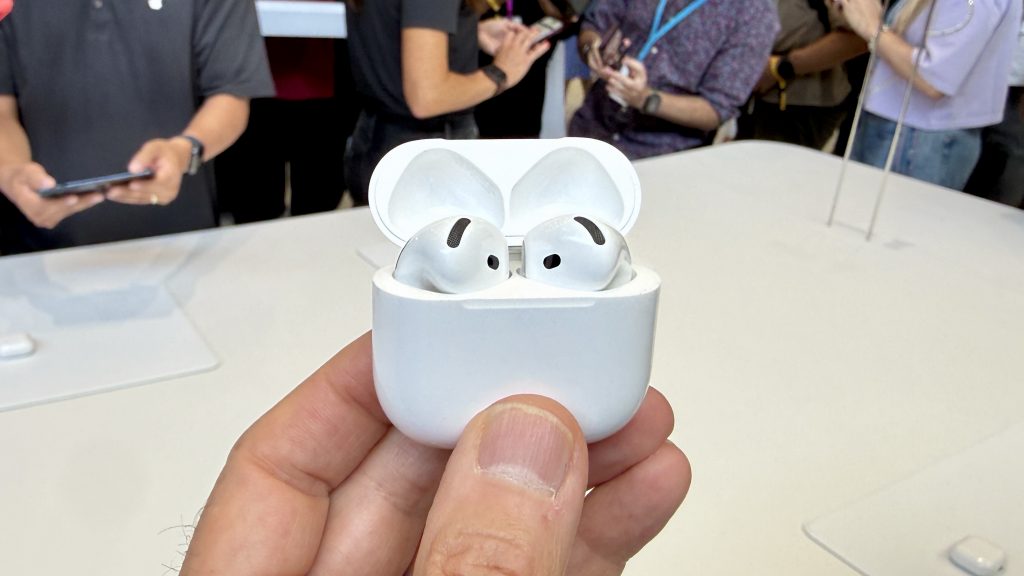
I originally anticipated the AirPods 5 would hit the market this year, aligning with Apple’s typical two-year refresh cadence for its AirPods lines. However, like many others, I questioned whether they would introduce Apple’s latest H3 processor—though neither AirPods 5 iteration utilizes it; both rely on Apple’s H2 chip. While visually identical to their predecessors, Apple states it has refined the buds’ internal acoustic architecture, resulting in a slight improvement in sound fidelity.
The AirPods 4 with Active Noise Cancellation represented a technological breakthrough. ANC is uncommon in open-ear designs due to technical challenges, yet as I detailed in my earlier review, the AirPods 4’s ANC performed respectably compared to top-tier models from Bose and Sony, proving surprisingly effective despite not matching them closely. Now, Apple claims its newer generation achieves 50% greater noise cancellation performance.
Similar to its predecessor, the entry-level AirPods 5 carries a non-wireless-charging case, whereas the premium model’s case does support wireless charging. Nevertheless, the lower-cost option retains active noise cancellation functionality at the same $129 price point. The primary distinction between the two configurations lies in battery endurance: the entry model delivers approximately four hours of playback with noise cancellation activated at moderate volumes (extending to six hours when disabled), while the step-up version offers up to five hours (seven hours with the feature turned off). Additionally, the premium model incorporates volume control knobs on the stems, mirroring the AirPods Pro 3 layout. Apple also reports improvements to the transparency mode for both variants, delivering a more natural audio experience. Furthermore, the AirPods 5 achieve an IP57 water-resistance rating, allowing full submersion, whereas the AirPods 4 are limited to IP54 protection.
Having spent time handling the devices, the noise cancellation clearly feels stronger, particularly in its ability to dampen higher and mid-frequency sounds. Although it still trails significantly behind the AirPods Pro 3 in overall noise suppression, the enhancement is notable. My brief evaluation of sound quality revealed impressive clarity and bass response, with better instrument separation than previously encountered. Among the leading open-ear buds on the market, these AirPods 5 rank among the best in terms of tonal performance.
I will publish a comprehensive review of the AirPods 5 in the upcoming days, including an in-depth examination of acoustic qualities and voice calling capabilities.