


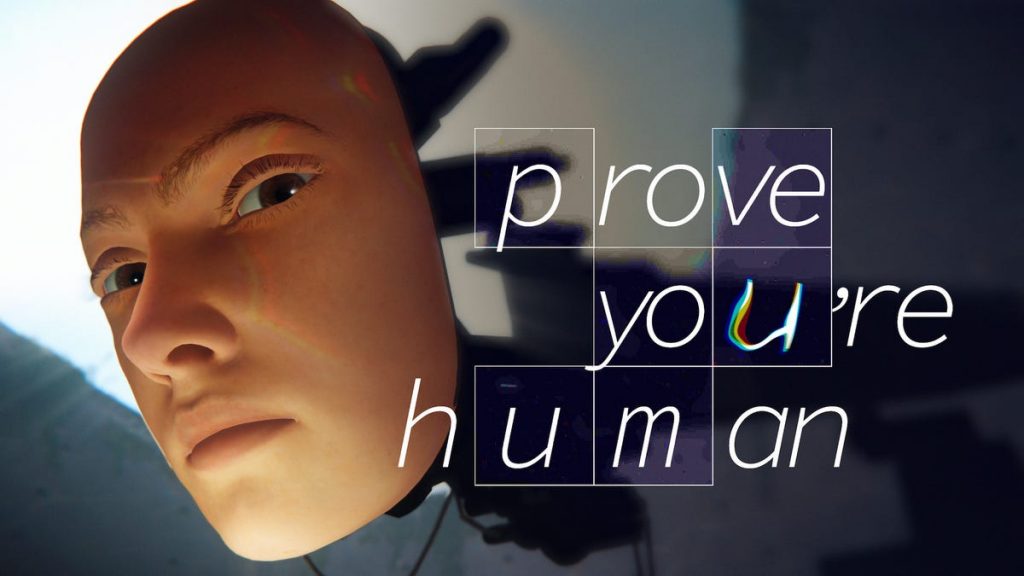
If you’re flustered at how much AI chatbots chat like humans, there’s an upcoming indie game with your name on it.
During the Triple-i Initiative showcase in early April, the studio Sunset Visitor (creators of 1000xResist) unveiled its next title, Prove You’re Human. The narrative game puts players in the role of a person trying to convince an AI that they aren’t human — and with a creative team full of former performance artists, it’ll get pretty existential from there.
The trailer is evocative yet scarce on details, which is fitting for the first look at a game that doesn’t have a release date yet. Given the indie success of Sunset Visitor’s debut title about cloning and personhood, 1000xResist, expectations are high for another cerebral narrative. And as the first game under the new publishing arm of Black Tabby Games (makers of indie hit Slay the Princess), the game is sparking a lot of hope.
In a conversation with the Sunset Visitor founder, Remy Siu, I delved into Prove You’re Human, asking the crucial question: What even is this game? And while they’re not releasing too many details right now or even hinting at when it’ll be released, we talked plenty about how a science fiction game inspired by the hit TV show Severance and the rise of generative AI speaks to the moment we’re all living in — where people chatting with ChatGPT succumb to AI psychosis and AI proselytizers claim the technological singularity of true artificial intelligence is near.
Prove You’re Human «is a game where an AI dares to dream that she’s human, and you’ve been hired to put her in her place,» Siu said. «And by you, [I mean] you the player who has undergone an operation to split their consciousness into two: one virtual consciousness, and then what we’ve been calling your corporeal other, your meat body that continues to exist outside doing things.»
See what I meant about Severance?
As with the show, Prove You’re Human uses these layers of existence to comment on work selves versus outside-world selves. And as you’d expect for a group of former performance artists, there’s pageantry in this divide, with your digital work self (the one controlled by the player, rendered in 3D), who is occasionally sent messages from your outside self, which are depicted in full-motion video. (That’s the real-life video we see in the trailer.)
«She gets to have all of her dreams come true, and you are the version of yourself that is now trapped here doing all of the work,» said Abby Howard, co-founder of Black Tabby Games and the new Black Tabby Publishing arm.
«It’s an examination of our relationship with work in the year 2026. If you’re working for a corporation now, does the you that is spending time in the office get to enjoy the fruits of that labor?» said Tony Howard-Arias, also co-founder of Black Tabby Games.
In another reflection of our current reality, specifically AI in gaming in 2026, I asked if generative AI tools are being used in Prove Your Human’s development, either to generate code or assets. «It’s definitely not ending up in the game,» Siu said, while lamenting that AI tools are baked into usage on things as mundane as Google searches. Howard asserted that they just don’t engage with those tools or have a use for them, at Black Tabby Games.
«We make a conscious effort to not engage with this wherever possible,» Howard-Arias said. «But how do your eyes not fall on the automated Google summary at the top of your search results?»
Engaging with AI — and choosing what’s real
As a narrative game, players will spend time in Prove You’re Human engaging with the AI, called Mesa, to hopefully convince her that she’s not human. Appropriately, there’s another mechanic players will use to interact with the world around them: hold up a CAPTCHA window and select the boxes that aren’t real. Through this tool — again, Siu was vague to hide story details — players will engage with the concept of what is real and what isn’t. And like other aspects of the game, there’s a deep philosophy behind using a tool to declare the truth of things.
«Every CAPTCHA is asking the player to commit an act of violence. You have to choose whether something is a thing or not,» Siu said. «That kind of thing is unpacked in these conversations with the artificial intelligence.»
Indie games have engaged with the ethical quandary of seemingly simple binary decisions resulting in devastating consequences. The iconic 2014 game Papers, Please had players working as a low-level border patrol agent approving or denying entry, choosing whether to save your job at the expense of dooming people to horrible fates. Prove You’re Human seems like it will use CAPTCHAs to similarly challenge players to make tough choices.
«One of the very first CAPTCHAs Remy showed us during his pitch was an image of a group of soldiers holding guns, and it said ‘select all boxes that contain arms in them,'» Howard-Arias said. «So it’s with the context provided an unanswerable question that puts you in a complicated position that causes some disquiet.»
I pointed out that using CAPTCHAs will likely date this game as being from a specific era, and Siu agreed that a decade from now we might use different, more complex verification tools. But he’s sanguine that the game will look and feel like it came from 2026. Art is defined by the contexts and time in which they’re made, he pointed out.
«I do want people playing 10 years from now, when they’re playing this game, to understand what we were thinking in this particular time,» Siu said.
Why indie games are the best medium for pondering AI
Similar to how Prove You’re Human results from our current anxieties around AI in 2026, Sunset Visitor’s first game, 1000xResist, is a product of 2020. It was developed during the beginning of the COVID-19 pandemic — indeed, Siu says it wouldn’t exist without the pandemic, as the early-pandemic themes of isolation and connection found their way into the game.
Half a decade later, the world has shifted its focus to a new era of smarter AI, financial inequality and labor issues. «For us at the studio, we’re always trying to make games that accompany you through life, and also is very porous with the world in which it’s made,» Siu said.
While Prove You’re Human is engaging with our current reality, telling a story about AI ensconces the game in the grand tradition of science fiction and its forays into artificial intelligence. There’s tension in adding to a proud tradition of theoretical yarns about smart entities we may one day create while living in 2026 during the actualization of it, Siu says.
Science fiction has plenty of overlap among AI, personhood and labor concerns, from Fritz Lang’s seminal Metropolis to Isaac Asimov’s I, Robot to Severance. Siu hinted that there are «things that Severance has left on the table that I would love to get at in this game.» While there are parallels with that show, he added that Sunset Visitor was more influenced by the animated series Pantheon, which deals with consciousness uploaded to digital networks and the value of work created by an artificial being.
«Games as an artistic medium almost beg questions about the nature of self and consciousness in the immersive way we interact with and embody a character,» Howard-Arias said.
The most popular science fiction video games have been titles from large-scale AAA developers like the Mass Effect and Dead Space franchises, which have world-building elements and story beats common to sci-fi subgenres (space opera and space horror, respectively). Prove You’re Human is an indie game made at a smaller scale with far more philosophical underpinnings. Indie games have more leeway to investigate themes and gameplay further from the mainstream, Siu said, allowing its developers to go the distance in ways that can cater to an audience unsatisfied by games from AAA developers.
«I do think this game, first and foremost, is for audiences which are narrative psychos, people who really want to see how narrative is being played with, unobstructed by a lot of concerns that larger developers may have,» Siu said. «Hopefully that creates something that you can’t get anywhere else.»
Sunset Visitor’s first release, 1000xResist, found an audience of gamers who engaged it with depth and nuance to a degree that surprised Siu, bucking the assumption that they’d only get such attention from fans of film or traditional fine and performing arts spaces.
In developing Prove You’re Human, he’s more optimistic about what levels of complexity players will engage with. That desire for deeper games has aligned Sunset Visitor with Black Tabby Publishing, and Siu noted the value of having Abby and Tony, the makers of the successful narrative game Slay the Princess, collaborate on his studio’s next game from a very early stage of development.
«The only way to foster this sort of love of literature within the audience, and the only way to grow the medium, is to make challenging works,» Howard-Arias said.